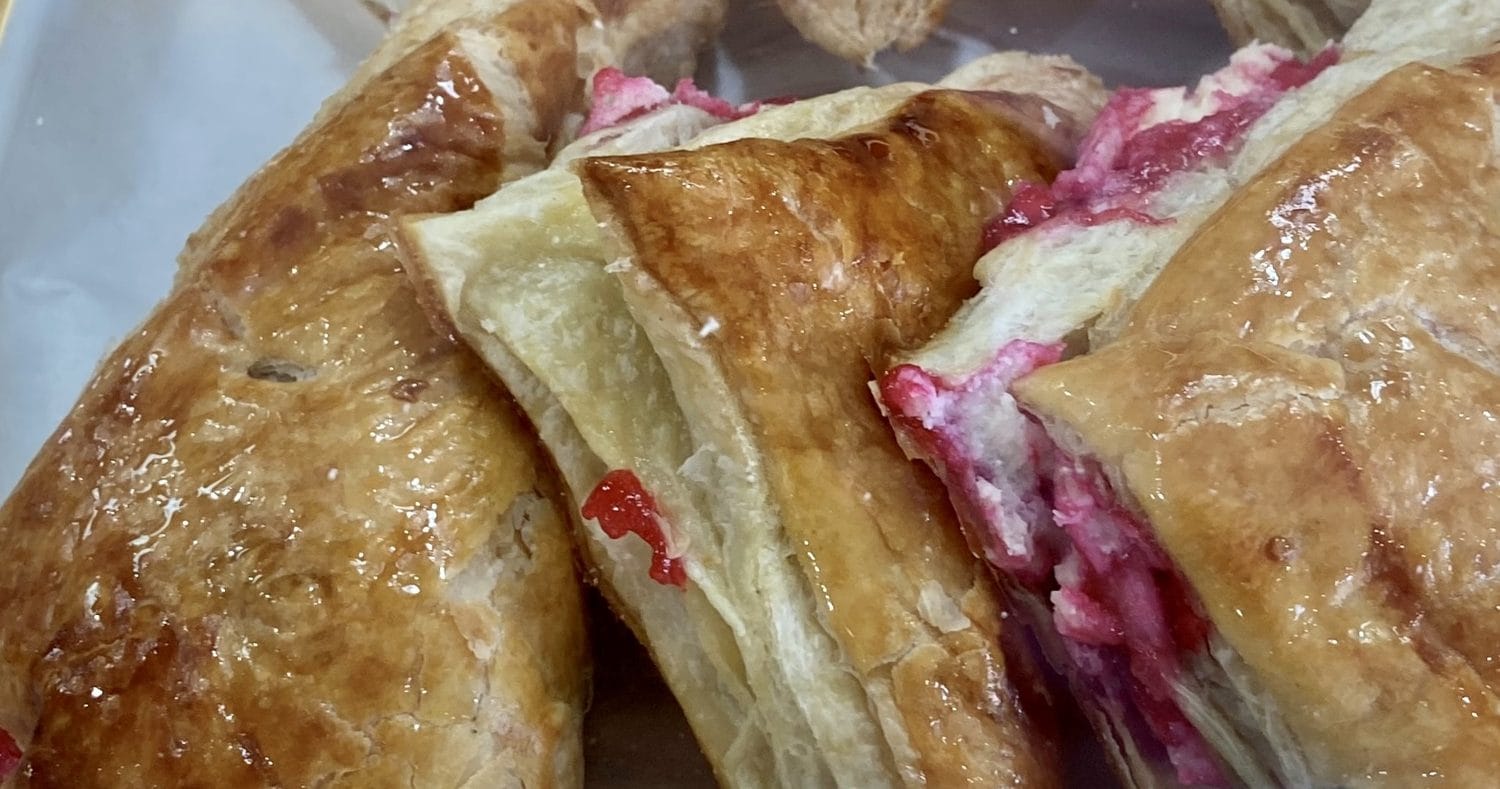
Cuban pastelitos de guayaba are baked puff pastry squares filled with firm guava paste, usually with cheese alongside it. The edges are sealed with egg, the tops are vented so steam escapes, and a brush of egg and a pinch of sugar give the finished pastry its glossy bakery top.
Guava paste comes as a firm block. It holds its shape as it warms instead of turning to syrup.
What are pastelitos de guayaba?
Cuban pastries, called pasteles or pastelitos in Spanish, are baked puff-pastry parcels with a sweet or savory filling. Guava and cheese is the classic pair. Cream cheese quesitos, pineapple and coconut are the others you will see in a case (source).
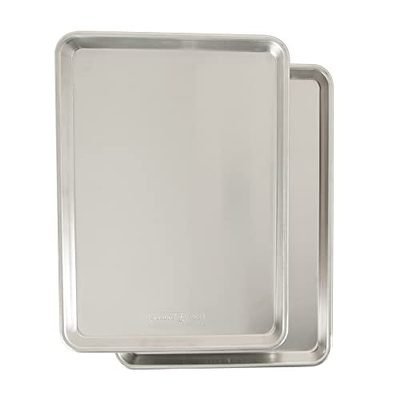
Puff pastry needs a flat, heavy sheet so the bottoms brown at the same rate the tops do. Commercial-weight aluminum will not warp when the oven runs hot enough to lift the layers.
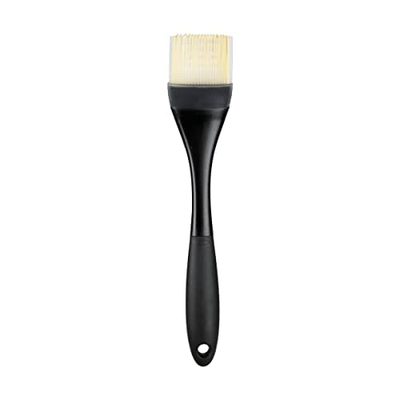
The egg wash is what gives pastelitos their shine, and a heavy hand with it glues the layers shut at the edge. Silicone bristles lay it on thin and rinse clean of egg.
The filling is guava paste, a Hispanic American confection made by simmering guava pulp with sugar for hours and cooling it into firm blocks that slice cleanly (source). The fruit under it is Psidium guajava, a small tropical tree native to tropical America whose fruit is eaten raw and cooked down into jams, jellies and preserves (source).
In Miami these are counter food. Guava pastries are sold beside Cuban coffee at the walk-up window at Versailles in Little Havana, along with croquetas (source). Both of those have their own recipes here: croquetas de jamon, minced ham bound in a thick milk sauce and fried, and pan cubano, a lard-enriched loaf with a seam pressed down its top.
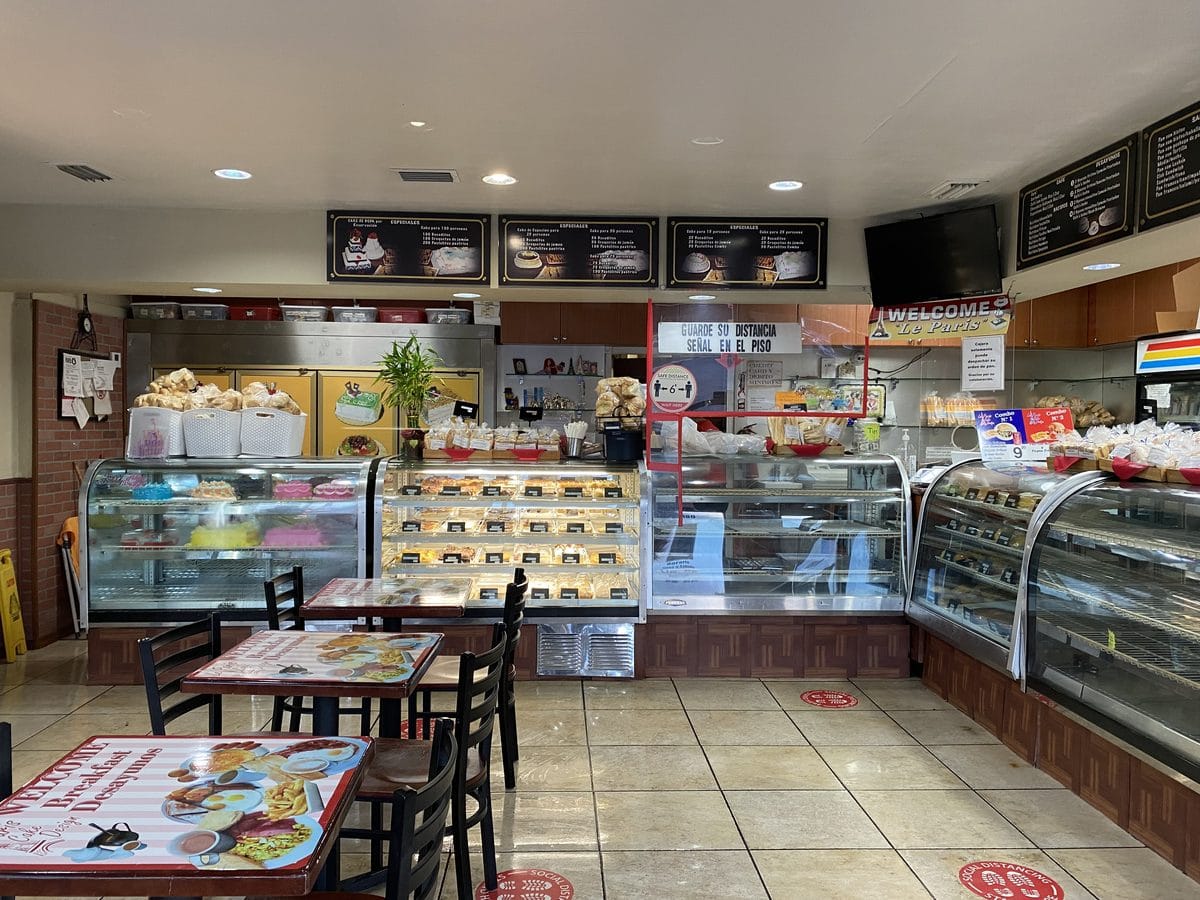
Guava paste, never guava jam
Jam is too loose, and that matters more than it sounds. It liquefies in the oven and runs out of every edge before the pastry has set. Paste, by contrast, stays where it is put. Buy the firm block, usually a flat tin or a wrapped bar in the Latin aisle. If it slices cleanly and holds its shape on the board, it is the right product.
Two other things also keep the filling inside. Brush beaten egg around the borders before the top goes on and press the layers down with your fingertips; the egg is glue, and it sets in the heat. Then cut vents in the top so the steam building under the pastry has somewhere to go. Without them it pushes out through the seam and takes the guava with it.
One long diagonal slit down the center works well enough. Three cuts work better: the diagonal plus a shorter one on each side, each stroke going all the way through the top layer.
What you need for Cuban pastelitos de guayaba
- 1 box (17.3 oz / 490 g) frozen puff pastry, 2 sheets, thawed
- 7 oz (200 g) guava paste, cut into thin rectangles
- 7 oz (200 g) queso blanco or full-fat cream cheese, cut into thin slices
- 1 large egg (about 2 oz / 50 g), beaten
- 2 tbsp (30 ml) water
- 2 tsp (8 g) white granulated sugar, for sprinkling
- 1 tbsp (8 g) all-purpose flour, for dusting the work surface
Buy the puff pastry, because nobody laminates dough for a weekday pastry. A thin sheet also gives a better result than a thick one. A US box holds two sheets at about 490 g, close enough to a 500 g European block that no adjustment is needed.
The cheese is a real choice and both answers are right. Queso blanco is the pairing most Cuban households grew up on. Cream cheese is softer and sweeter and just as common in Miami kitchens. Cheese is optional altogether; guava alone is a perfectly ordinary pastelito.
How long pastelitos de guayaba take
| Thawing the pastry | about 40 minutes |
| Prep | 25 minutes |
| Baking | 20 to 30 minutes |
| Total | about 55 minutes of work |
| Makes | 6 pastelitos |
How to make Cuban pastelitos de guayaba
- Thaw the pastry completely. Frozen sheets need about 40 minutes on the counter. Refrigerated sheets are ready as they are. Pastry still cold in the middle cracks when you unfold it, and pastry left out too long past that point turns sticky. The window is not wide.
- Heat the oven to 350°F (180°C) and line a baking sheet with parchment.
- Cut the filling. Guava paste into thin rectangles about 2 in (5 cm) long and 1/4 in (6 mm) thick. Cheese into slices the same size.
- Beat the egg with the water in a small bowl.
- Roll out the first sheet. Dust the work surface with flour, unfold the pastry, roll it just enough to even it up and trim the edges square.
- Cut 12 rectangles. Six from each sheet: 6 bottoms and 6 tops.
- Fill the bottoms. A piece of guava paste in the center of each, cheese on top of the guava if you are using it, and a clear border all the way around.
- Egg the borders. Brush beaten egg around all four edges of each filled rectangle. This is what holds the pastelito shut in the oven.
- Seal. Lay a second rectangle over each one and press the borders down with your fingertips, all the way around.
- Vent the tops. Cut a long diagonal slit down the middle of each, with a shorter one on either side, each stroke going through the top layer only.
- Move them to the tray, spaced apart.
- Glaze. Brush the tops with the remaining egg and sprinkle each with a pinch of white sugar.
- Bake 20 to 30 minutes, until deep golden and the pastry has puffed into visible layers. Start checking at 20; ovens differ more than recipes do.
- Cool 5 minutes on the sheet, then move to a wire rack. The filling comes out molten and needs a few minutes before it is safe to bite.
Tips and variations
- The whole-sheet method. Space the fillings across one full sheet, cover with a second sheet, then cut the pastelitos apart with a pizza cutter, running the wheel down the empty lanes. Cutting all the way through lets the pieces separate cleanly instead of fusing in the oven. It is the fastest route to a full tray.
- Triangles from one piece of dough. Fold a single square over the filling instead of sandwiching two. Less pastry per piece and quicker to assemble. Seal and vent it the same way.
- A hotter oven costs you the filling. At 400°F the crust crisps beautifully in 20 minutes, but the guava can come out of a longer bake still firm rather than melted. Lower and slower is the safer default.
- Party size. Cut the pieces smaller and one box makes twelve instead of six.
- Guava alone. Skip the cheese entirely. Plenty of households prefer them that way.
- Baked, not fried. These are an oven pastry. Frying puff pastry is a different dish.
Where they sit on the table
Breakfast, mostly, with strong Cuban coffee, and then again in the afternoon when the coffee comes back out. They are counter food rather than a plated dessert, eaten standing up as often as sitting down.
Nothing here borrows from a Belizean pantry. This is a Cuban pastry with its own rules. If small sweet pastries out of a shop case are what you came for, there is the Belizean coconut tart, and tembleque is the Caribbean dessert with the shortest shopping list on this site.
Nutrition
Estimated, for one of 6 pastelitos, based on the amounts above and standard ingredient labels. These are large pastries and the numbers reflect that rather than rounding down.
| Calories | 565 kcal |
| Protein | 7 g |
| Fat | 34 g |
| Saturated fat | 13 g |
| Carbohydrates | 56 g |
| Sugar | 24 g |
| Fiber | 2 g |
| Cholesterol | 45 mg |
| Sodium | 270 mg |
Storing pastelitos de guayaba
They are best the day they are baked, while the pastry is still crisp, so plan to eat them. At room temperature they hold for 2 days in a loosely covered container. A sealed airtight box traps steam and softens the crust instead of protecting it. Refresh a day-old pastelito in a 350°F (180°C) oven or an air fryer for 5 to 7 minutes. The microwave turns the pastry limp.
To freeze them unbaked, assemble, seal and vent as usual, freeze on a tray until firm, then bag them. Bake straight from frozen at the same temperature and add about 5 minutes. Brush the egg wash on just before they go in, not before freezing.
Refrigerating baked pastelitos is the worst of the three options. The pastry goes leathery in the cold. If it is the only option, reheat in a hot oven rather than a microwave.
Equipment you will want
- A baking sheet and parchment paper.
- A rolling pin.
- A pizza cutter, or a sharp knife.
- A cutting board and a small bowl for the egg wash.
- A pastry brush and a wire cooling rack.
Pastelitos de guayaba questions, answered
What is the difference between guava paste and guava jam in pastelitos?
Paste is guava pulp simmered with sugar for hours and cooled into a firm block you slice (source). Jam is loose and runs out of every edge of the pastry as it bakes. So use the paste.
Can you use frozen puff pastry for pastelitos de guayaba?
Yes, and you should, since nobody laminates dough for a weekday pastry. Thaw a frozen sheet completely first, about 40 minutes on the counter, because pastry still cold in the middle cracks when you unfold it. Refrigerated sheets need no thaw. A standard US box holds two sheets at about 490 g, which is close enough to a 500 g block that nothing needs adjusting.
Why did my pastelitos leak guava out of the sides?
One of three things. You used jam instead of paste. The borders were not sealed with beaten egg before the top went on. Or the tops were not vented, so steam built up with nowhere to go and pushed the filling out at the seam. Fix all three and the leak stops.
What cheese goes in pastelitos de guayaba?
Queso blanco or cream cheese, and neither is more correct. Queso blanco is the older pairing and holds its shape better in the heat. Cream cheese is softer and sweeter. Cheese is optional entirely; guava alone is a normal pastelito.
How long do you bake pastelitos de guayaba and at what temperature?
350°F (180°C) for 20 to 30 minutes, until deep golden. Start checking at 20, because ovens differ more than recipes do. A hotter oven crisps the crust faster but can leave the guava firm rather than melted, so lower and longer is the safer setting.
Can you freeze pastelitos de guayaba before baking them?
Yes. Assemble, seal the edges with egg and cut the vents. Freeze on a tray until firm, then bag them. Bake straight from frozen at the same 350°F (180°C) and add about 5 minutes. Brush on the egg wash just before they go in.
How many pastelitos per person?
One is a generous portion at this size, two if they are the smaller party cut. A box of pastry makes 6 large or 12 small, so plan on one box for six people at breakfast.
Cutting chilled puff pastry into even rectangles wants a wide surface, not a small board crowded by two sheets. Maple also stays kinder to a knife edge than hard plastic does.