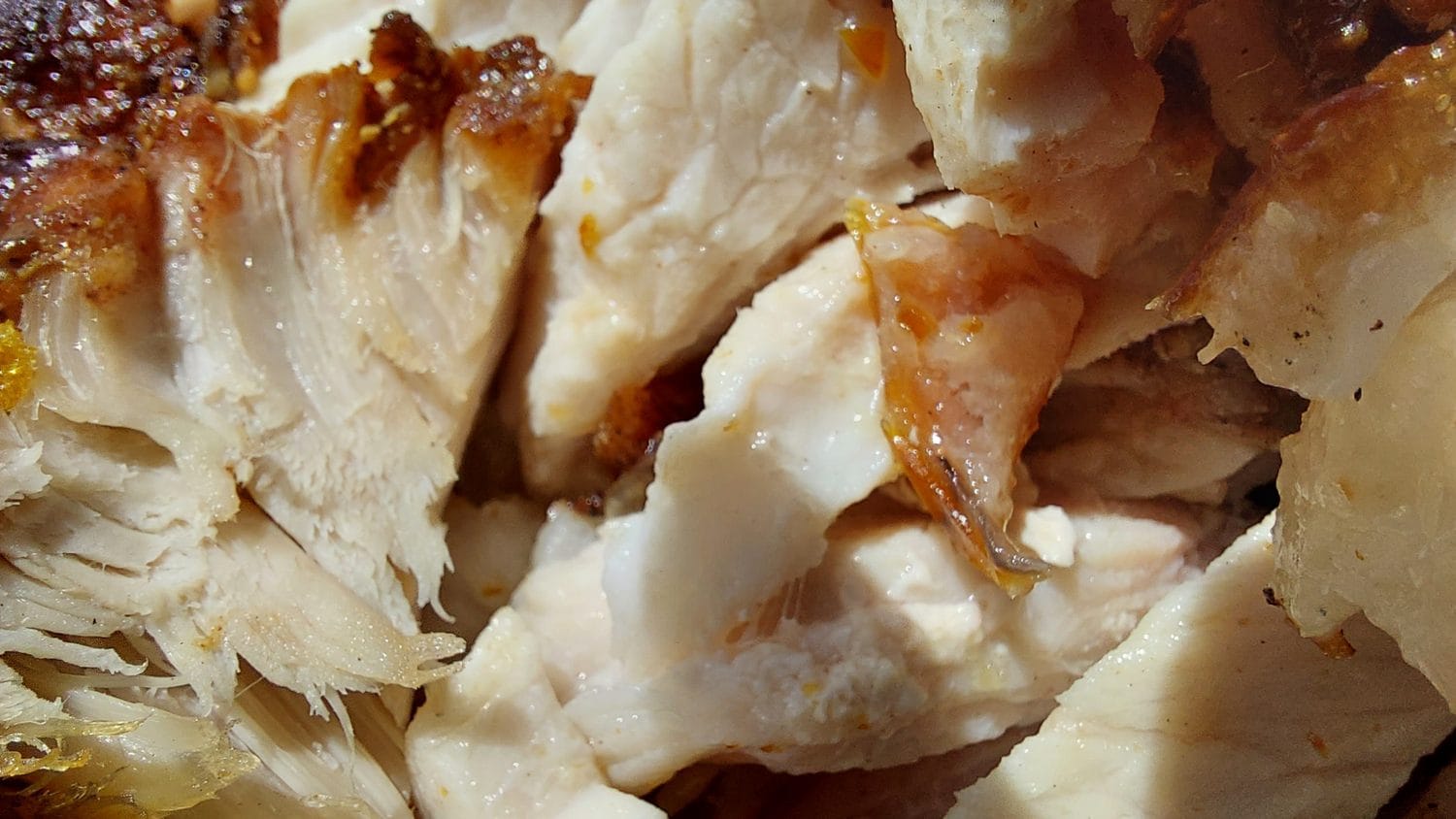
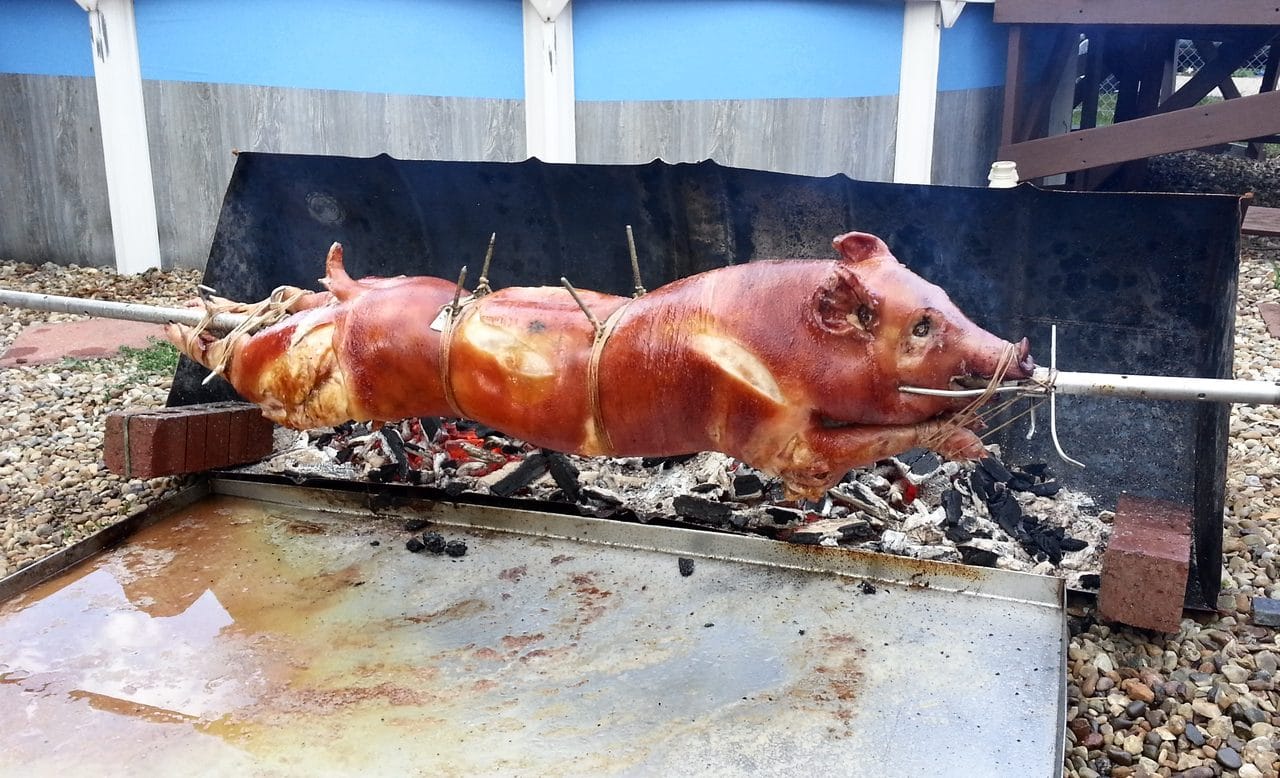
Cuban lechon asado is pork marinated in mojo, a sour orange and garlic marinade seasoned with cumin, oregano and bay leaf, then roasted low until the meat pulls apart and the skin crisps. In Cuba the classic version is a whole pig over coals (source). At home, though, it is a bone-in shoulder in the oven.
The Cuban marinade has no achiote and no sofrito. Instead, sour orange and garlic do all of it.
What is lechon asado?
Lechon means a roasted suckling pig, and the classic dish is that whole animal cooked over charcoal (source). It sits at the center of Nochebuena, Cuba’s Christmas Eve dinner, though it is claimed as a national dish in several countries, not Cuba alone.
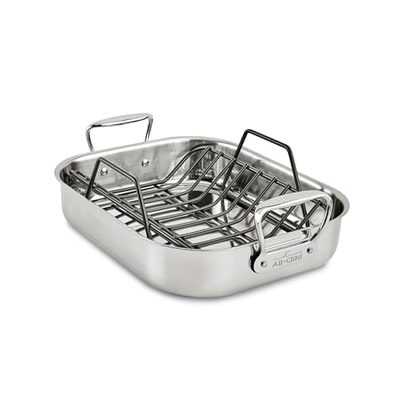
Eight pounds of bone-in shoulder needs a pan that will not buckle at a low oven for five hours. The rack keeps the skin up out of the rendered fat, which is the only way it crisps when the heat goes up at the end.
Cuisinart Pro Custom 11-Cup Food Processor with Slicing & Shredding Discs (DLC-8SBCYP1)
Spice pastes built from garlic, citrus and dried chiles need a processor that grinds them smooth in one pass. An 11-cup bowl is sized for batches that get portioned and frozen.
So what goes in a home oven is the same mojo on a bone-in shoulder. That is Cuban practice rather than a compromise, and it is what this recipe covers. The marinade is the dish; the cut is whatever the night allows.
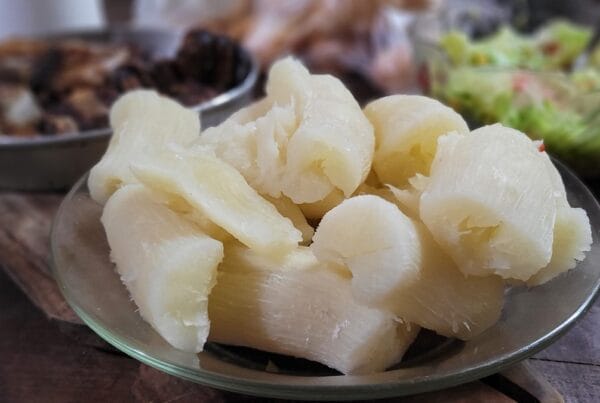
Still, pork is not reserved for December. It carries Christmas Eve, New Year’s Eve, and most of the year in between. The plate around it is congri, black beans and white rice cooked together in one pot, yuca con mojo, boiled cassava dressed in hot garlic oil, bread, and salad. Belize keeps its own roast for the season, the ham that goes on a Belizean Christmas table, and it owes nothing to this one.
Cuban mojo is not Puerto Rican adobo
This is where lechon asado separates from Puerto Rican pernil, and the differences are all load-bearing.
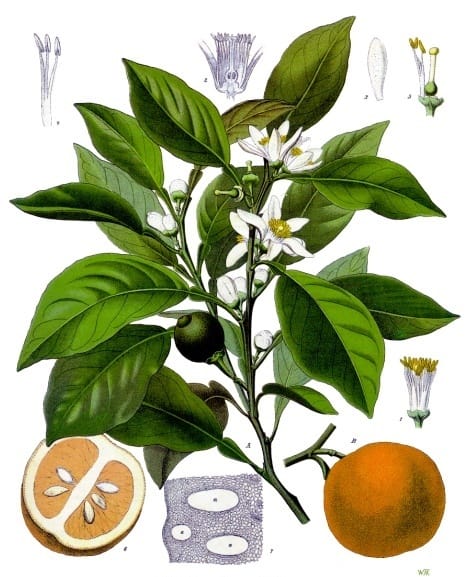
The acid. Cuban mojo runs on naranja agria, sour orange. Pernil, meanwhile, runs on white vinegar. Sour orange is Citrus aurantium, and its juice is used as a flavoring on fish and on meat during cooking; in Yucatan it is employed like vinegar (source). The same fruit stands in for sour orange in Yucatecan cooking, doing the job vinegar does elsewhere.
The aromatics. But there is no achiote and no sofrito in the Cuban marinade. It is garlic, onion, cumin, oregano and bay. Mojo in Cuban cooking means any sauce of garlic, olive oil or pork lard and a citrus juice, traditionally bitter orange, used to marinate roast pork (source). When sour orange marries achiote you have cochinita pibil, which is a different dish entirely.
The application. Cuban mojo, then, is a liquid. So it goes into knife slits and often straight into the meat with a marinade syringe. Pernil’s is a thick paste worked by hand into deep cuts. Liquid against paste, injected against packed.
The equipment. The asado en pua, a whole pig on a spit, and the caja cubana, a charcoal box, have no equivalent in the pernil tradition. Both are covered further down, after the recipe.
What you need for Cuban lechon asado
For the pork
- 1 bone-in pork shoulder, picnic or Boston butt, 8 lb (3.6 kg), skin on
For the mojo
- 1 1/2 cups (355 ml) sour orange juice (naranja agria), or 3/4 cup (180 ml) fresh orange juice plus 3/4 cup (180 ml) fresh lime juice
- 20 cloves garlic (about 1/2 cup, 70 g), peeled
- 1 medium white onion (about 7 oz / 200 g), roughly chopped
- 1/3 cup (80 ml) extra virgin olive oil
- 2 tbsp (36 g) coarse sea salt or kosher salt
- 1 tbsp (6 g) dried oregano
- 2 tsp (4 g) ground cumin
- 2 tsp (4 g) black pepper, coarsely ground
- 1 tsp (2 g) ground bay leaf, or 3 whole bay leaves crushed fine
- 1/4 cup (10 g) fresh cilantro, chopped (optional)
- 1/4 cup (10 g) fresh parsley, chopped (optional)
For the skin
- 1 tsp (6 g) fine salt
Twenty cloves is not excessive for eight pounds of shoulder, because most of it mellows in the long roast. Garlic goes in by the handful here rather than by the clove. If sour orange is not on the shelf, half fresh orange juice and half fresh lime juice is the standard fix, and bottled naranja agria works too.
Olive oil or pork lard, either one. Lard makes a heavier mojo and is the older choice, although either one works. Neither is more Cuban than the other (source).
How long lechon asado takes
| Marinating | 12 to 24 hours, not counted below |
| Prep | 30 minutes |
| Covered roast | about 3 hours 30 minutes |
| Uncovered, for the skin | 20 to 30 minutes |
| Rest | 20 minutes |
| Total on the day | about 4 hours 30 minutes |
| Serves | 12 |
How to make Cuban lechon asado
- Blend the mojo. Garlic, onion, oregano, cumin, pepper, ground bay, salt, sour orange juice and olive oil, in a blender until it pours easily. Cilantro and parsley go in last if you use them.
- Cut deep. Knife slits several inches into the meat, angled toward the center, so the marinade has somewhere to go.
- Loosen the skin without removing it. Slide the knife underneath and separate it from the meat, leaving it attached along one edge so it lifts like a lid.
- Get the mojo inside. Pour it into the slits and under the skin, rub what is left over the meat beneath the flap, then lay the skin back down.
- Dry-salt the skin. Pat the top dry and rub the fine salt over it. Marinade sitting on the skin is what stops it crisping.
- Marinate cold, 12 to 24 hours. Do not go past 24. The citrus starts working on the texture beyond that.
- Take it out an hour before it goes in the oven.
- Roast covered at 325°F (165°C), tented with foil, about 3 1/2 hours for an 8 pound shoulder.
- Pull the foil and raise the heat to 400°F (205°C) for 20 to 30 minutes, watching it, until the skin blisters and goes hard.
- Check the temperature. 170°F (77°C) at the thickest part, away from the bone.
- Rest 20 minutes under foil, then pull or slice. Break the skin into pieces and serve it beside the meat so it stays crisp.
170°F is the number for a shoulder you are slicing. Take it to 203°F (95°C) instead if you want meat that pulls apart for sandwiches, which is a different finish rather than a longer version of the same one.
Tips and variations
- The whole pig on a spit, asado en pua. The classic version, and what Nochebuena is actually about (source). A pig of about seventy pounds goes on a pole of guava or guasima wood over a pit dug 20 to 30 cm into the ground, turned slowly for four to six hours. The fire has to be coals, never flame, and guava leaves thrown on the coals at the end give the smoke.
- Keep the marinade off the skin on a spit roast, the opposite of the shoulder method above, so the cuerito crisps clean over the fire.
- Buying a whole pig? Choose a female, or a male castrated young. An uncastrated boar develops an off flavor in the heat that no marinade covers.
- Injecting versus slitting. A marinade syringe reaches deeper than a knife, but it spreads the salt unevenly if you are careless. Do both: inject the thick parts, slit the rest.
- Do not trim the fat, and do not let the skin get wet before it goes in the oven. Wet skin does not crackle.
The caja china. A plywood box lined with aluminum, four feet long, two feet wide and twenty inches deep, the whole pig inside, and the lid doubling as a metal tray that holds the charcoal (source). A fifty-pound pig cooks in about four hours, and the fat dripping onto the coals is where the smoke comes from. It sounds old and it is not: the commercial La Caja China started in Florida in 1985, after Roberto Guerra’s father saw boxes like it in Havana’s Chinatown in 1955 (source).
Where it sits on the table
Roast pork, black beans and rice, and bread is the whole Noche Buena plate in plenty of Miami households (source). On the island the plate usually widens to congri, yuca con mojo and a salad alongside the pork.
The names travel, so Miami’s own holiday coverage calls the same pig lechon or pernil interchangeably (source). What holds this dish apart from the Puerto Rican one is the marinade and the method, not the word on the menu.
Nutrition
Estimated, for one of 12 servings off an eight pound bone-in shoulder, based on the amounts above and standard ingredient labels. Sodium assumes most of the marinade salt stays in the pan. Eating the skin raises the fat and sodium noticeably.
| Calories | 560 kcal |
| Protein | 40 g |
| Fat | 43 g |
| Saturated fat | 15 g |
| Carbohydrates | 3 g |
| Sugar | 1 g |
| Fiber | 0 g |
| Cholesterol | 150 mg |
| Sodium | 720 mg |
Storing lechon asado
Refrigerate leftovers up to 4 days, sealed, with some of the pan juices. Reheat covered at 300°F (150°C) with a splash of those juices so the meat does not dry out.
The pulled meat freezes up to 3 months. The skin does not freeze at all, so eat that the day it comes out of the oven.
Leftover mojo that touched raw pork has to be boiled hard for 5 to 10 minutes before it goes anywhere near cooked meat. Do that and it makes a good sauce for the pulled pork.
Equipment you will want
- A heavy roasting pan with a rack.
- A sharp boning or paring knife, for the slits and for lifting the skin.
- A blender or food processor for the mojo, or a mortar and pestle to crush the garlic by hand.
- Aluminum foil.
- An instant-read thermometer.
- A marinade syringe (jeringuilla), optional but common.
Lechon asado questions, answered
What is Cuban lechon asado?
Pork marinated in mojo, a garlic and sour orange marinade with cumin, oregano and bay, roasted until the meat comes apart and the skin turns hard and crisp. In Cuba it is the centerpiece of Nochebuena (source). This recipe is the oven version, a bone-in shoulder standing in for the whole pig.
What is the difference between Cuban lechon asado and Puerto Rican pernil?
The marinade and how it goes on. Cuban mojo is sour orange with no vinegar, no achiote and no sofrito, all three of which are in pernil’s. Mojo is a liquid poured or injected into slits; pernil’s marinade is a thick paste worked in by hand.
Can I make mojo without sour orange?
Yes. Half fresh orange juice and half fresh lime juice is the standard substitution and it lands close. Bottled naranja agria is sold in Latin groceries if your store carries it.
How long should pork marinate in mojo?
12 to 24 hours, no less and no more. Less and the citrus has not reached the meat. Past 24 hours the acid starts breaking the texture down instead of seasoning it.
What is a caja china?
A plywood box lined with aluminum, four feet long and two feet wide, built to hold a whole pig, with the lid doubling as a charcoal tray (source). It reads old but it is a Florida invention from 1985, built after a Cuban immigrant’s father remembered boxes like it in 1950s Havana.
What do Cubans serve with lechon asado?
Black beans and rice, bread, yuca con mojo and a salad. Some households stop at pork, beans and bread (source); others fill the table. Congri and yuca con mojo both have their own recipes here.
How much pork shoulder per person?
About 2/3 lb (300 g) of bone-in shoulder each, which is where 8 lb for 12 comes from. Bone and fat account for a good third of the raw weight, so do not buy by finished portions.
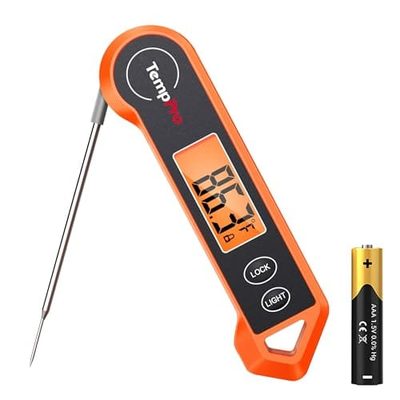
Lechon asado is finished by internal temperature, not by the clock, and shoulder pulls apart at around 190F. An instant-read probe answers that in a few seconds without holding the oven open.
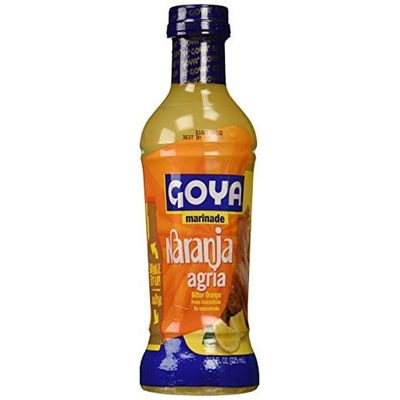
Sour orange is the acid the mojo marinade is built on, sharper and far less sweet than the orange-and-lime stand-in. Bottled naranja agria keeps in the fridge and saves hunting for the fresh fruit.