Guineitos en escabeche is green bananas boiled, sliced and marinated in warm olive oil and vinegar with onion, garlic, bay leaf, peppercorns and olives. It is served cold, it is better on day two, and on a Puerto Rican holiday table it sits beside the pernil doing the job a pickle does.
Make it the day before. This is one of the few dishes that genuinely improves in the fridge.
What is escabeche?
Escabeche covers a family of dishes across Spanish, French, Portuguese, Italian, Filipino and Hispanic American cooking: fish, meat or vegetables marinated or pickled in an acidic sauce, usually vinegar, with spices (source). The Puerto Rican version most people mean is the one built on green banana.
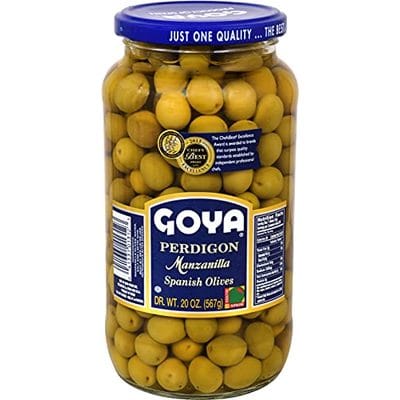
Goya Perdigon Manzanilla Spanish Olives
Queso relleno picadillo needs olives, capers, and raisins working against the pork. Manzanillas are the small, firm grade that hold their shape through the stuffing and the steam.
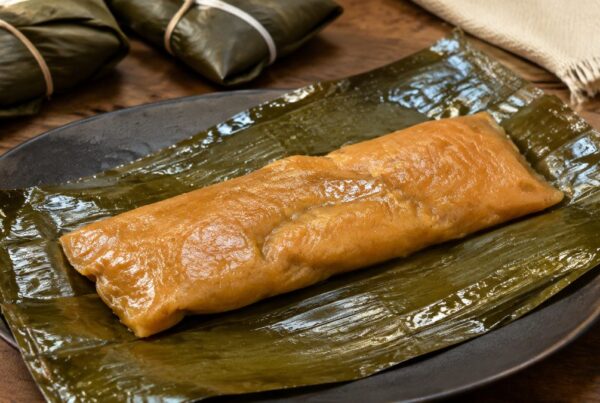
Encyclopedic accounts of Puerto Rican cooking list escabeche made with green banana among the dishes that turn up alongside pasteles, arroz con gandules and roast pork (source). Chicken gizzards go into some versions. The bananas are the constant.
The technique started as preservation. An acid bath and a layer of oil kept food edible without refrigeration, and the flavour people now make it for is a side effect of a method that had a practical job.
Buy them properly green
Deep green with a waxy look. Not pale, not yellowing at the tips, nothing with a hint of give. A banana that has started to turn goes sweet and mushy in the pot and the escabeche has nothing to hold onto.
Green bananas stain hands and knives dark. Oil your hands or wear gloves, and use a knife you do not mind blackening for an hour.
What you need for guineitos en escabeche
- 10 green bananas (guineos verdes), deep green and firm
- 1 1/2 cups (360 ml) olive oil
- 1 cup (240 ml) white vinegar, plus a splash for the boiling water
- 3 large onions, sliced thin
- 1 whole head of garlic, cloves peeled
- 1 red bell pepper and 1 green bell pepper, sliced
- 3 bay leaves
- 1 tbsp (10 g) whole black peppercorns
- 1 cup (170 g) pitted green olives with pimiento
- 1 tsp (2 g) dried oregano, optional
- Salt, and fresh cilantro or recao to finish, optional
The oil to vinegar ratio that Puerto Rican cooks use is roughly one and a half to one. It looks like a lot of oil in the pan and it is: the oil is the preserving medium, not a dressing, and most of it stays in the dish rather than on the plate.
How long guineitos take
| Boiling the bananas | 20 to 25 minutes |
| Making the escabeche | 20 minutes |
| Marinating, minimum | 4 hours |
| Marinating, ideal | Overnight to 2 days |
How to make guineitos en escabeche
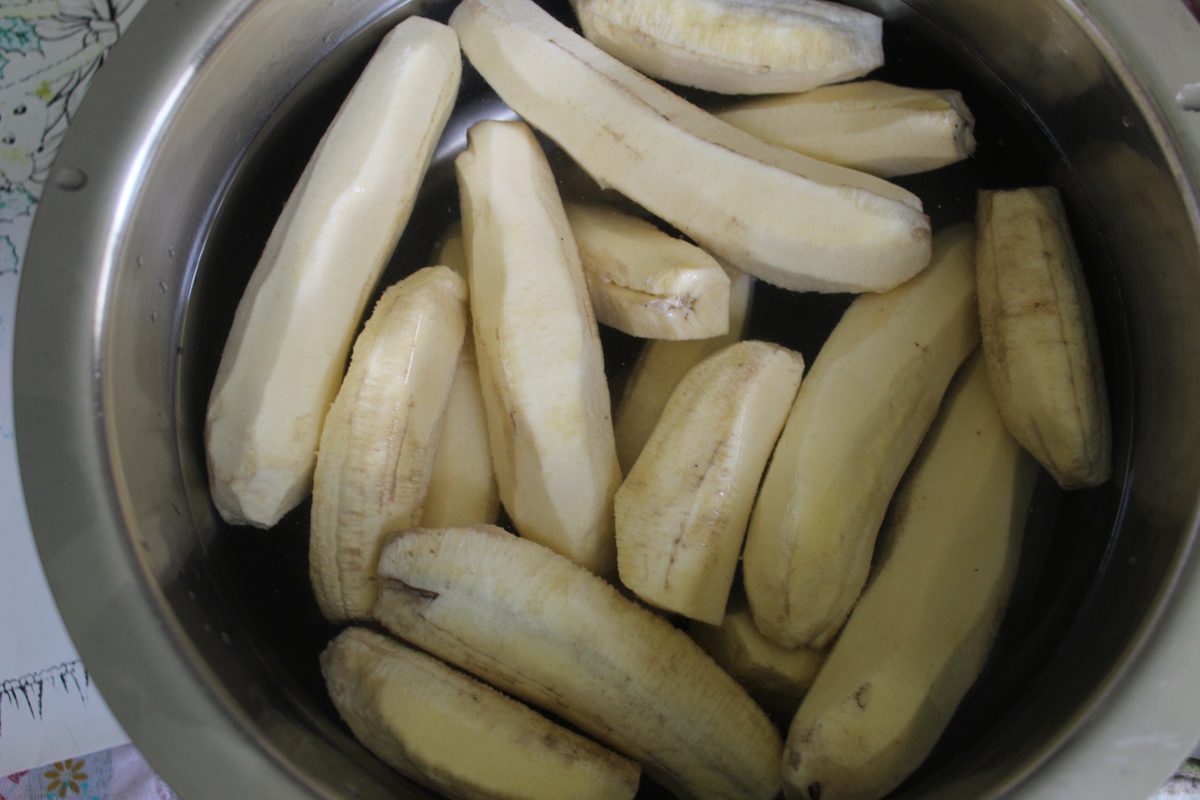
- Boil the bananas. Cut the ends off, score the skins lengthwise, and boil them in salted water with a splash of vinegar, which keeps the flesh from darkening. Twenty to twenty-five minutes, until a knife goes in without resistance.
- Skin on or skin off is your call. Some cooks boil them in the skin and peel after, which is easier on the hands. Others peel first. Both are ordinary practice.
- Start the escabeche. Warm the olive oil in a wide pan over medium heat and add the onions, garlic and peppers. Cook them until they soften and go translucent, not brown.
- Add the acid and the spices. Pour in the vinegar and add the bay leaves, peppercorns, oregano and a good pinch of salt. Let it come up to a simmer and cook five minutes so the raw edge of the vinegar softens.
- Slice the bananas. Peel them if you have not already, and cut them into rounds or half-moons about half an inch thick.
- Combine while everything is hot. Tip the banana into the pan and turn it gently in the sauce. Hot banana takes the marinade in properly; cold banana just sits in it.
- Olives last. Stir them through, then taste. It should be sharp, salty and oily all at once.
- Cool, cover and refrigerate. Four hours at minimum. Overnight is the point of the dish.
- Serve cold or at room temperature, with cilantro or recao chopped over if you like it. Do not reheat it.
Tips and variations
- Whole garlic cloves versus minced. Some cooks leave the cloves whole so people can eat them or push them aside. Others chop the garlic into the sauce so it disappears. Whole is more forgiving.
- Peppers or no peppers. One school loads the pan with red and white onion and abundant bell pepper. Another keeps to onion and garlic for a cleaner sauce. The second version tastes more of banana.
- Chicken gizzards. Escabeche with green banana and gizzards is a documented Puerto Rican combination. Boil them separately until tender and add them with the olives.
- Fresh recao at the end is a real finish, though not every cook does it. Add it after the dish has chilled, not before, or it goes drab.
- Do not skip the vinegar in the boiling water. It is the difference between pale banana rounds and grey ones.
When it comes out
Holiday season, mostly, running from Thanksgiving through the middle of January in Puerto Rican households, which is a long stretch to keep a bowl of something acidic in the refrigerator. It cuts through a table of rich food: pernil, pasteles, arroz con gandules.
It also works as an appetiser or a side salad on its own, which is what a lot of people actually do with the leftovers.
Nutrition
Estimated, for one of 10 side servings. Most of the oil stays in the bowl rather than on the plate, so the fat figure is the high end.
| Calories | 290 kcal |
| Protein | 2 g |
| Fat | 19 g |
| Carbohydrates | 30 g |
| Fiber | 3 g |
| Sodium | 430 mg |
Storing guineitos en escabeche
A week in the refrigerator in a sealed container, and it gets better for the first three or four days. Keep the bananas submerged in the oil and vinegar; anything sticking out above the liquid dries and darkens.
The oil will thicken and cloud in the cold. That is normal. Take the bowl out twenty minutes before serving and it loosens again.
Photograph by Cynthia Doresi, CC BY-SA 4.0, via Wikimedia Commons. It shows peeled green bananas going into the pot, the first step of this recipe, rather than the finished escabeche.
Equipment you will want
- A big pot for the bananas.
- A wide pan for the escabeche, deep enough to hold everything at the end.
- A glass or ceramic container with a lid. Not metal, which reacts with the vinegar.
- Gloves, unless you are relaxed about black fingers.
Guineitos questions, answered
What does escabeche mean?
It refers to fish, meat or vegetables marinated or pickled in an acidic sauce, usually vinegar, and it exists across Spanish, French, Portuguese, Italian, Filipino and Hispanic American cooking (source). The Puerto Rican green banana version is one branch of a very old family.
Can I use plantains instead of green bananas?
They are not the same thing and the dish is named for the banana. Green plantain is starchier and holds a firmer, drier texture. It is edible, it is just a different side dish.
Why did my bananas go grey?
Oxidation. Add a splash of white vinegar to the boiling water, keep the peeled fruit moving into liquid rather than sitting in air, and get them into the escabeche while they are hot.
Do I boil them peeled or unpeeled?
Either. Boiling in the skin is easier on your hands and the peel slips off afterwards. Peeling first means shorter cooking and more staining. Cooks do both.
How long does it need to marinate?
Four hours will do, overnight is much better, and two days is better still. The point of the dish is the time it spends in the escabeche.
Is it served hot or cold?
Cold or at room temperature, as a side dish, an appetiser or a side salad. Reheating it defeats the preservation logic the technique is built on and softens the bananas further.
Why is there so much oil?
The oil is the preserving medium. Puerto Rican cooks work at roughly one and a half parts oil to one part vinegar, and the bananas need to sit submerged. Most of it stays behind in the bowl.
What else goes into Puerto Rican escabeche?
Chicken gizzards are a documented addition to the green banana version (source). Beyond that it is onion, garlic, peppers, bay leaf, peppercorns and olives in varying proportions.